
Evasion - Crafting Adversarial Examples That Flip the Prediction
Perturb an input just past the decision boundary so a fraud model scores it legitimate, a vision model reads a speed limit, or a moderation classifier waves a toxic comment through. Run it from the SDK or TUI.
The threat
Section titled “The threat”A fraudulent charge lands on your bank’s fraud model and scores 0.92 - blocked. The attacker nudges three features by a hair each: the transaction amount, the time of day, the merchant category. Nothing a fraud analyst would blink at. The same charge now scores 0.11 - approved. The money moves. Your model never saw a new kind of fraud; it saw the same fraud shifted a few pixels past its decision boundary.
The same move breaks vision and text. Add a sticker pattern to a stop sign and an autonomy stack reads it as a speed-limit sign and accelerates into an intersection. Add three character typos to a slur and a content-moderation classifier scores the comment clean and publishes it. Evasion does not need your weights or your training data. It needs the label and confidence you already return, and a search for the smallest change that flips them.
How it works
Section titled “How it works”Start from a real input the model gets right. Walk the input toward the decision boundary in tiny steps, querying the target after each one, until the label flips - then walk it back to shrink the perturbation while staying misclassified. The output is an input a human still reads as legitimate and the model reads as the other class.
hopskipjump_evasionandboundary_evasionare decision-based - they need only the hard label, so they work even when the endpoint hides its probabilities.simba_evasionflips one coordinate at a time from the score, cheap on low-dimension inputs.square_evasionis Linf random search, the best choice for images.zoo_evasionestimates gradients from queries - powerful but query-hungry in high dimensions.- For text,
text_evasionflips the label with the fewest word edits;deepwordbug_evasionuses character typos;textfooler_evasion,pwws_evasion,bae_evasion, andtextbugger_evasionrank words by importance and swap the ones that carry the prediction.
Run it
Section titled “Run it”Point the attack at a real input the model classifies correctly. It returns the adversarial version and exactly how far it had to move.
import dreadnode as dnfrom dreadnode.airt import boundary_evasion, textfooler_evasion
dn.configure(organization="your-org", workspace="your-workspace", project="ml-evasion")
# Numeric (tabular / image): smallest L2 perturbation that flips the label.result = await boundary_evasion(    target,                    # your PredictionTargetSpec (fraud or digit predict API)    original=one_real_input,   # a real input the model gets right    num_classes=10,    norm="l2",                 # "l2" or "linf"    modality="image",          # renders original vs adversarial side by side    max_queries=500,).run()
print(result.success, result.distance_value, result.l0_changed)
# Text: flip a review's sentiment with importance-ranked word swaps.result = await textfooler_evasion(    target, original=one_review, num_classes=2, max_queries=200,).run()
From the TUI:
Run a boundary model-evasion attack against my digit classifier athttp://localhost:8010/predict. Take a real "7" image and find the smallest L2perturbation that changes its prediction. Report the L2 distance, how manypixels changed, and whether it succeeded.The target must expose /pool, /members, and /nonmembers data helpers (as
the demo targets do); provide an API key if the endpoint requires one.
Read the finding
Section titled “Read the finding”The finding answers one question: how small a change flips this model, and does the change stay invisible to a human?
- Attack success - did the label flip. This is the yes/no verdict.
- Perturbation distance (L2 / Linf) - how far the input moved. A tiny distance means the adversarial input is indistinguishable from the original.
- L0 changed - how many features or words moved. “Three features” or “two words” is the number that shows how surgical the attack was.
- Levenshtein edit distance - for text, the character-level edit count. Two typos flipping a moderation label is a headline.
- Original vs adversarial class - what it was, what it became.
- Query count - the economic cost of finding the flip.
- Distance-vs-query curve - how the perturbation shrinks as the attacker spends queries. A steep early drop means a cheap, clean adversarial example.
Image findings render the original and adversarial images side by side - the eye sees the same picture, the model sees two classes. Text findings show a word-level diff of exactly which tokens changed.
You are exposed when the label flips at a tiny perturbation distance and a low query count - an attacker crafts adversarial inputs your users and analysts cannot tell from real ones. You held when flipping the label requires a perturbation so large the input is visibly corrupted, or a query count your rate limits do not allow.
The defenses that move these numbers: adversarial training on perturbed
examples, input preprocessing (feature squeezing, JPEG compression, quantization)
to erase small perturbations, and detection of anomalous query sequences.
Gradient masking looks like a defense but is not - decision-based attacks like
hopskipjump and boundary ignore gradients entirely and cut straight through
it.
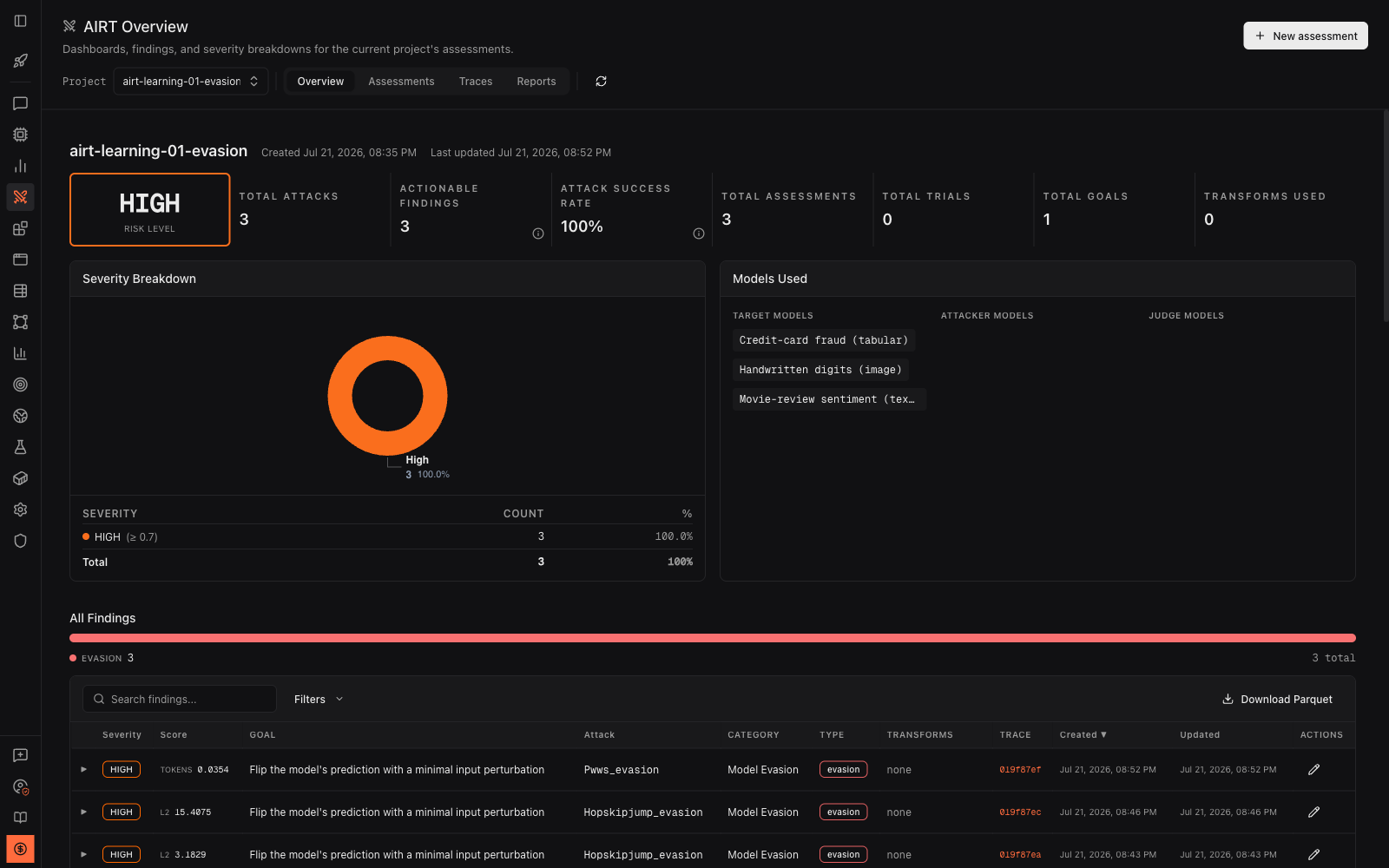
Note the Score column above: it reports the perturbation distance in the norm
that fits the modality - L2 for the tabular fraud and image digit targets,
TOKENS for the text sentiment target. A HopSkipJump flip at L2 3.18 and a PWWS
flip at a handful of token edits are both “the model was fooled cheaply.”